
Blooming
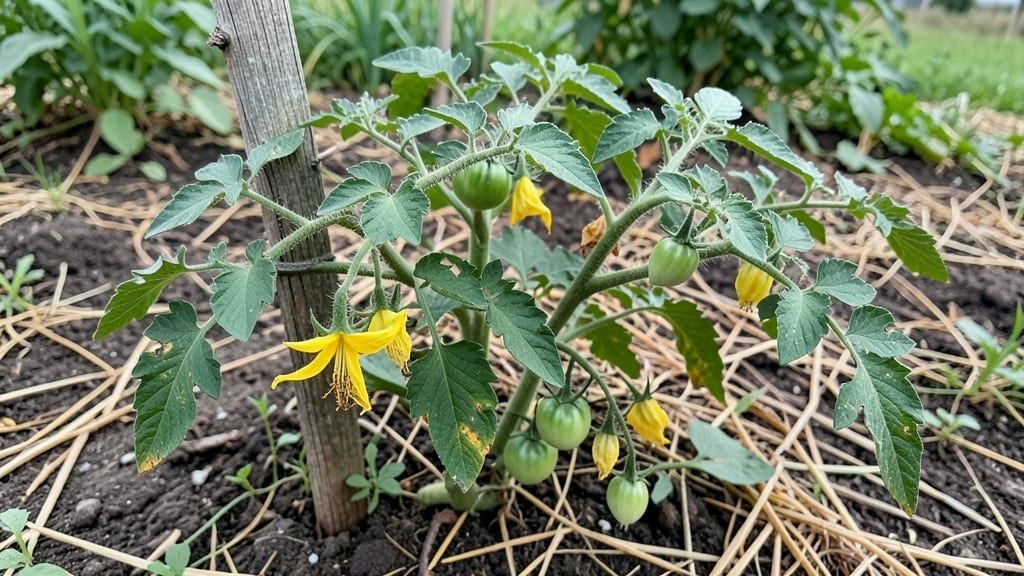
When a tomato plant blooms early, it suggests a faster harvest ahead—but achieving strong fruit development requires consistent warmth, sunlight exposure, and attentive care. Unexpected chilly weather can still harm delicate blossoms or young fruit.
Early blooming is often a sign of ideal growing conditions, but it also means your tomatoes are more vulnerable in their first stages. 🌱 The plant’s energy shifts from leaf growth to fruit production, which demands extra nutrients and stable temperatures.
I’ve seen firsthand how a sudden drop below 50°F can cause blossom end rot or dropped fruit—so monitoring forecasts becomes crucial during this phase. Varieties like 'Early Girl' or 'Stupice' are bred to handle cooler starts, while heat-lovers like 'Solar Fire' may struggle if nights stay chilly.
To maximize your harvest, focus on even moisture (never soggy soil) and a balanced fertilizer like 10-10-10 to support both flowers and developing fruit. Pruning suckers early helps direct energy to existing blossoms rather than new growth.
The key is patience—rushing to harvest can leave fruit undersized, while letting it mature fully ensures sweeter, more flavorful tomatoes.
💡 In This Article
- Factors Influencing Early Tomato Blossoming
- Managing Early Blooms for Maximum Tomato Yield
Factors influencing early tomato blossoming
Here's what's actually happening when your tomato plant flowers early: it's responding to a combination of environmental triggers and genetic programming. The most critical factor is day length—tomatoes are short-day plants, meaning they flower when daylight hours shorten (typically after summer solstice).
However, many modern varieties are bred to ignore this rule and bloom early when soil temperatures reach 55-60°F. This is why greenhouse-grown tomatoes often flower weeks ahead of outdoor plants—the controlled warmth bypasses the natural photoperiod response. 🌡️
The science gets even more interesting with vernalization, a cold exposure requirement some varieties need to trigger flowering. For example, 'Stupice' tomatoes (a cold-hardy heirloom) require 2-4 weeks at 40-50°F before they'll reliably bloom.
You can test if your plant is cold-sensitive by exposing it to 40°F nights for 10-14 days—if it blooms afterward, it's vernalization-dependent. Heat-loving varieties like 'Solar Fire' skip this step entirely, relying instead on consistent warmth above 70°F to kickstart flowering.
This genetic difference explains why some plants bloom in May while others wait until July.
Daylight quality matters too—tomatoes detect red and far-red light ratios through a process called photomorphogenesis. Cloudy skies or shade cloth can delay flowering by altering this ratio, even if temperatures are ideal.
I've noticed that plants under 30% shade cloth often bloom 7-10 days later than unshaded counterparts, despite identical soil temps. This is why gardeners in northern climates sometimes use supplemental grow lights to maintain the proper light spectrum during short spring days. 🌿
Don't overlook the role of plant hormones in this process. Gibberellins (growth hormones) promote stem elongation, while florigen (the flowering hormone) accumulates in leaves when days shorten. The plant's ability to produce florigen depends on photosynthesis efficiency, which is why nutrient-deficient plants often take longer to bloom.
A quick test: healthy leaves should be deep green with prominent veins—pale or yellowing foliage signals the plant is prioritizing survival over reproduction. This hormonal balance explains why over-fertilizing with nitrogen can delay flowering—too much leaf growth starves the plant's flowering centers.
Variety selection is the final piece of the puzzle. Determinate tomatoes (like 'Roma') are bred to bloom all at once for a single harvest, while indeterminate types (like 'Better Boy') produce continuous flowers. The difference?
Determinates have a built-in flowering trigger that activates when the plant reaches a certain size, regardless of external conditions. Indeterminates, however, keep producing flowers as long as conditions remain favorable—this is why they're often the first to bloom in spring but may struggle if summer heat arrives suddenly. 🌸
What most people don't realize is that soil temperature matters more than air temperature for early blooming. Roots need to be consistently above 60°F to support active growth—cold soil slows nutrient uptake and delays flowering.
This is why black plastic mulch can make a 2-3 week difference in bloom time compared to bare soil. The mulch warms the soil by absorbing sunlight and radiating heat back to the roots, creating an optimal environment for early flower development.
This simple technique explains why professional growers often achieve harvests weeks ahead of home gardeners using the same varieties.